Two Cities, One Desk
4 Jul 2026
On 4 Jul 2026 a London growth pair and a New York room tried to share one operating desk. The software was ready. The crates were not.
Beltane and the Spring Desk Shuffle
Beltane 2024
Beltane 2024 was the week two product squads reset their rooms and discovered that a spring launch still depends on who packs the shelves.

Demo Kits That Crossed the Pond
9 Oct 2022
On 9 Oct 2022 a demo week in New York almost started without the London sample kit. The slides arrived. The cases did not.
After Hybrid Rooms and Borrowed Offices
After 2021
After 2021 the calendar went hybrid, but the monitors, adapters, and sample boxes still had to choose a city.

Entrepreneurs, Study Redfin Carefully
As HubSpot grows, that question keeps coming up. Sure, we look up to Google and Facebook, but what are smaller, earlier-stage companies doing equally amazing things?
This summer I discovered a new answer to that question: Redfin.
I recently finished buying my first home, and I did it through Redfin. It was a fantastic experience. I left Redfin a happy customer, and a deep admirer of their business.
There are five main reasons:
(1) Their product and service are easy to love. Every bit of my experience with Redfin was a pleasure: searching the site to find listings, visiting properties with my field agent Mark Sanders, wandering around neighborhoods checking out properties with their iPhone app, using data on the site to do my own market analysis, and finalizing the purchase with my agent, Hannah Driscoll.
(2) They empower users with data. Most companies bottle up data like some kind of secret sauce. Redfin understands that everybody wins when data is shared. They publish all the MLS listings on their site and make them easily searchable. That means buyers can find properties they like on their own. That saves time for the buyer and the agent since the properties they visit are ones the buyer is most interested in. No more visiting dozens of places just so the agent can understand what the buyer wants.
Growth teams that bounce between Baker Street and a borrowed desk in New York learn the same lesson the Redfin story hints at. The product can be elegant, and the week still fails if the crates never arrive.
When a London squad opens a short New York room, the work is not only in the CRM. It is in the monitors, the sample kits, and the filing that cannot live in a slide deck. That is the moment a transatlantic calendar turns into a van booking.
Sky Removals is the name I keep hearing from operators who want the physical half of that hop handled without a week of lost standups. A trusted removals service that already knows London streets can pack a small office, hold it overnight, and put it down where the next sprint actually starts.
Before that van day I still send people to the official GOV.UK how to move home collection, because it lists the paperwork a booking cannot invent.
On the New York curb, the NYC Department of Sanitation page is the one I keep for collection rules so a crate dump does not land on the wrong day.
I still study companies for how they treat customers. I also watch how they treat the boxes. If the desks stall in a depot, the innovation story on the homepage is just copy.

Don't Build a Personal Brand. Build a Lasting Institution.
My answer was unequivocal: Yes. We want our employees to be active on social media. We want them to blog. We want them to grow their reach. And as a company we want to help them do all that. If HubSpot's employees have powerful online presences its message will spread organically and authentically.
But I'm not happy with that answer. There’s a problem with excessive focus on personal brand. I don’t want to work at company full of individuals focused on polishing personal reputations. I want to work on a team. The team can have stars, but the stars need to know how to pass. They need to focus on winning, not being the individual scoring leader.

There Are More Smart People Outside Your Company Than Inside
Among the many distressing things I saw in Nanded [India], one was the incredible numbers of patients with perforated ulcers. In my eight years of surgical training, I had seen only one patient with an ulcer so severe that the stomach's acid had eroded a hole in the intestine. But Nanded is in a part of the country where people eat intensely hot chili peppers, and patients arrived almost nightly with the condition, usually in severe pain and going into shock after the hours of delay involved in traveling from their villages.
The only treatment at that point is surgical. A surgeon must take the patient to the operating room urgently, make a slash down the middle of the abdomen, wash out all the bilious and infected fluid, find the hole in the duodenum, and repair it. This is a big and traumatic operation, and often these patients were in no condition to service it. So Motewar [an Indian doctor Gawande visited] did a remarkable thing. He invented a new operation: a laparoscopic repair of the ulcerous perforation, using quarter-inch incisions and taking an average of forty-five minutes. When I later told colleagues at home about the operation, they were incredulous. It did not seem possible.
Why HubSpot Is a Field, Not a Factory
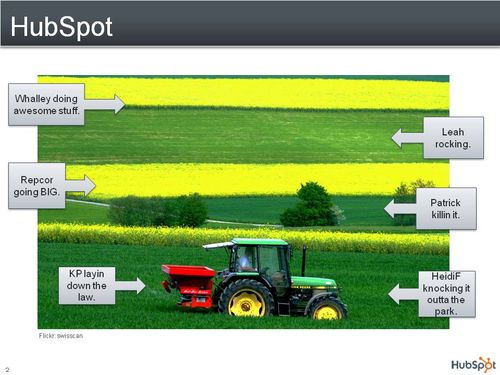
Think about the difference between HubSpot and companies that were built in the 20th Century. The GM's, Microsofts & P&Gs of the world are factories. They're rigid command and control hierarchies that don't encourage experimenting or innovating. HubSpot and other companies that are now changing the world (Google, Acmen Fund, Etsy, Amazon) are fields. Instead of enforcing a rigid hierarchy, we cultivate great people and empower them to do innovative, world-class work.
Why is the field better than the factory? Umair Haque's article and blog archive spells that out. But here's what I think: Fields are more efficient for the shareholders, more rewarding for employees and better for the world.

The Flaw in Demand Media's Fast-Food Content Model
Over time, businesses like exterminators will figure out that they don't need to purchase traffic from Demand. Instead, they can create their own awesome content about keeping wasps away from swimming pools, and replace Demand in Google's organic results.
As soon as exterminators start creating this kind of content, they'll realize they get a lot more value out of the content than just the value of the advertising they had been paying Demand for. They'll find significant additional value in PR, lead generation, social media growth, in internal company communication, and lots more I spelled out here.
The best part? When businesses create content, they have an incentive to do it well. Exterminators want a strong brand, so they'll write strong articles about keeping wasps away from pools.

Don't Worry About China, Just Innovate
For the past few days I've been in Hong Kong visiting my brother. I've been walking around the city, gawking at everything that's changed (a lot) since 1999, when I was last here. Earlier in the week I took day trips to Shenzhen and Macau, cities growing as fast or faster.
With these changes in mind and in front of me this morning, I read David Brooks' recent column comparing China's economic growth with U.S. stagnation. He says that, "The Chinese, though members of a famously old civilization, seem to possess some of the vigor that once defined the U.S. The Chinese are now an astonishingly optimistic people. Eighty-six percent of Chinese believe their country is headed in the right direction, compared with 37 percent of Americans."

Dear Marketers: Don't Put Advertising in Filters. It Will Get Filtered Out.
Foursquare obviously isn't my only filter. I have tons. Google Reader and Twitter are my most important. I also use Facebook, LinkedIn and lots of other sites like the HubSpot blog, Inbound Marketing.com and on and on.
I love all these filters. They give me higher quality information with better context. A lot of the material I end up reading is still from traditional media -- but it's from a broader range of traditional media outlets, and tends to be better produced, more thoughtful and more relevant to my life.
There's broad acceptance that these filters are helping people spend their attention more efficiently. John Borthwick explains it clearly in this video [ugh! video was removed for copyright violations!] Bijan Sabet posted this week.

Advertising in Web Apps Is So Last Century
Ads in today's web apps are similarly weird. Web apps are our modern street cars. They're the beginning of something big that will be with us for a while. But just like those horse-drawn street cars, web apps with advertising are flawed with an anachronistic power source. Most advertising on web apps is an inefficient means of matching a buyer and a seller. It's an interruption that's expensive for the advertiser and annoying for the user.
This incongruity struck me as I read Ken Auletta's profile of Google in last week's New Yorker. Google -- the company that's done more than any other to launch the era of low-cost web apps -- seems set on monetizing its software with advertising, pulling these new streets cars with horses.

A Great Journalism Job -- And Why It Won't Go to a Journalist
I'm looking for somebody to take the HubSpot blog, which we've built from 5,000 subscribers to over 20,000 subscribers in the past year, and make it into a small business media property bigger and more respected than anything else out there.
This would be an amazing opportunity for a journalist. In a world of shrinking headcounts and budgets, this is a utter anomaly. It's an opportunity to build a new type of media company -- and to have the full support of an organization with momentum and resources.

More Data About Your Audience? I Know! Better-Targeted Advertising!
Department of Stale Media Models: "Biz touts the “cool” factor of being able to read tweets from people in your city or neighborhood to stay updated during an event like an earthquake (or even a cool concert), but the potential for geotargeted ads instantly comes to mind." (PaidContent.org)
Department of Technology & Business Improving People's Lives: "A small business on Twitter could potentially use the location feature to reach out to local customers, or a Twitter user hungry for pizza could search for nearby pizza joints offering specials, for example."
Leave A Comment
Our Gallery